Caves
The Harmanecká Cave ranks among the most important caves in Slovakia by remarkable origin of cave spaces, mighty breakdown domes, high abundance of moon milk, as well as by the number of wintering bats.
It is formed in the Middle Triassic dark-grey Gutenstein lime stones of the Choc Nappe along the tectonic faults with locally applied interbed surfaces. It reaches the length of 3,002 m (3,283 yd) with vertical span of 75 m (246 ft). Except for voluminous collapse spaces (Dome of Pagodas, Tall Dome, Stray Dome and others), there are horizontal and inclined passages with irregular oval shapes, however without typical signs of underground river modelling. Visitors can also find distinct collapses and spiral abysses.
The initial cave spaces were formed by corrosion of slowly flowing and almost stagnant water, when they were completely flooded. Mixed corrosion and slow convection flow of water formed irregular sponge-like and oval cupola hollows. After the decline of water-table, which is witnessed by here and there preserved level notches, the cave spaces were flooded only partially. The time of forming the primary underground spaces is probably related to the ancient inflow of waters from the edge part of the Kremické Hills (extraneous sediments floated from non-karst area were found in the cave) and to forming of surrounding planation surface in the Tertiary Period. Later on, several distinct collapses of roofs and walls occurred in many places of the cave, by which the original oval shapes were destructed and remodelled, by which debris fields, debris cones, mounds and bulwarks were formed. Except for collapses, also percolating atmospheric waters contributed to further forming of the underground spaces. Narrow fissure passages and chimneys were formed by their corrosive activity in the cave.
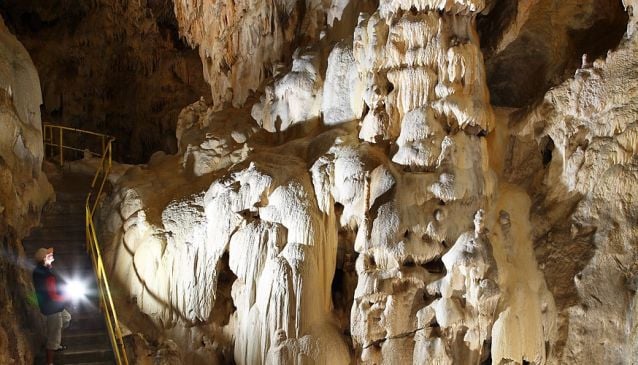
The cave is known by abundant occurrence of white soft sinter – moon milk. From among the sinter fills, mainly the mighty pagoda stalagmites, wall flow stone waterfalls and draperies catch your attention. There are two pagodas twelve meters high with three meters in diameter in the Great Dome. Air temperature in the cave is between 5.8 and 6.4 °C (42.4 and 43.5 ºF) and relative humidity 94-97%.
The cave belongs among the most important localities of bats occurrence in Slovakia. Eleven bat species were recorded in the cave by now. Dominating species are the Greater Mouse-Eared Bat (Myotis myotis) and Lesser Mouse-Eared Bat (Myotis blythii), which occurred here several times in amount of 1,000 to 1,500 individuals. Another abundant bat species in this cave is the Common Pipistrelle (Pipistrellus pipistrellus). Frequently, visitors can find here also the Daubenton’s Bat (Myotis daubentonii). The most important from the invertebrates are the multipede Allorhiscosoma sphinx and crustacean Bathynella natans.